How Engineering Helped Shape a Complex Modular Industrial Facility
Some modular projects are straightforward. Repetition drives efficiency, the structural logic stays familiar, and the system can be executed with relatively standard detailing.
Others ask for more.
This project was one of those cases. From the beginning, it involved more than simply stacking or arranging modular units. The design brought together multiple operational zones, different load demands, large wall openings, and long-span roof structures into one coordinated system. What emerged was not just a modular layout, but a much more involved structural problem that needed to be understood as a whole.
At the planning stage, the project included a variety of spaces with different intended uses. Some areas functioned as offices, while others were planned for equipment, storage, fabrication-related activities, and support functions. That mix mattered structurally. It meant the modules could not all be treated the same way. Floor loads, dead loads, and wall opening conditions had to be evaluated based on how each portion of the project would actually perform in service.
That is often where the real engineering work begins.
In modular design, it is easy to assume that because units start with a familiar form, they will behave in a familiar way. But once openings grow larger, uses become more demanding, and modules begin working together as part of a larger building concept, the structural behavior changes. A container or module stops being just an isolated unit and starts becoming part of a broader load path.
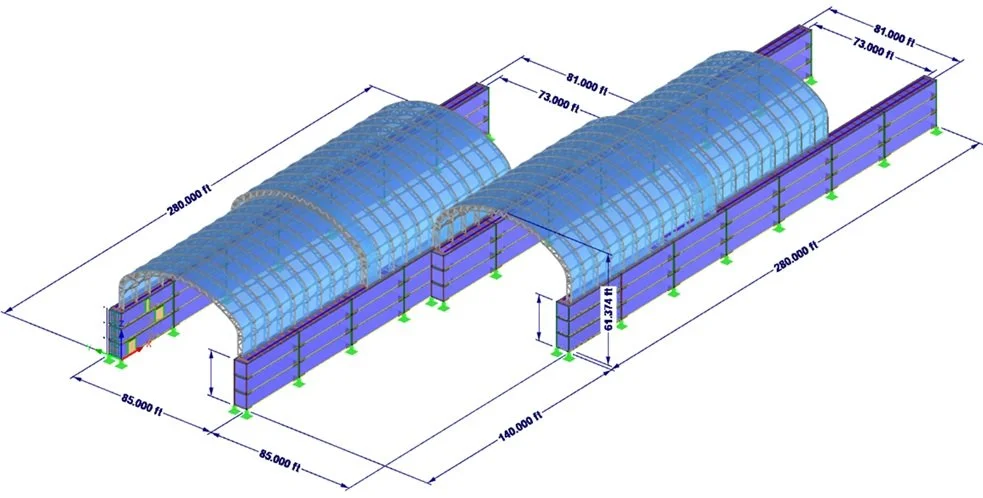
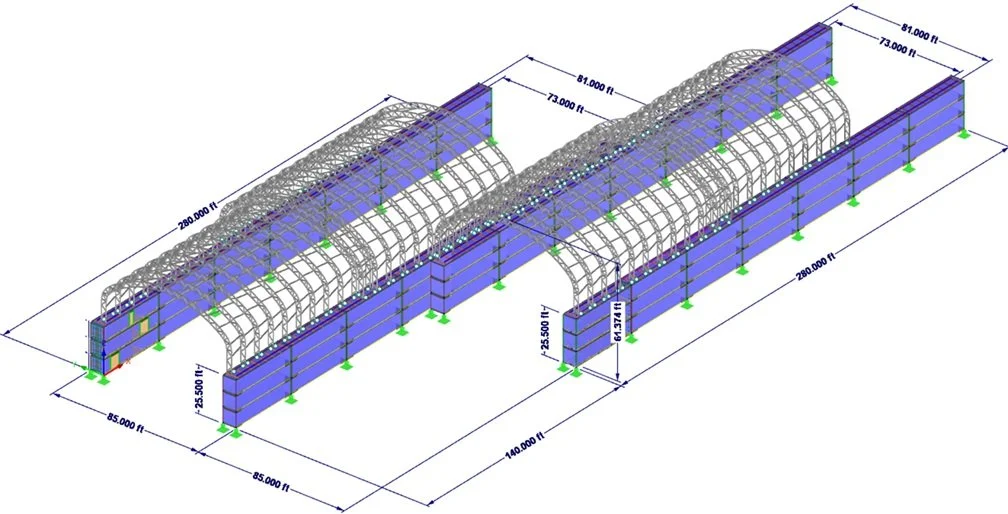
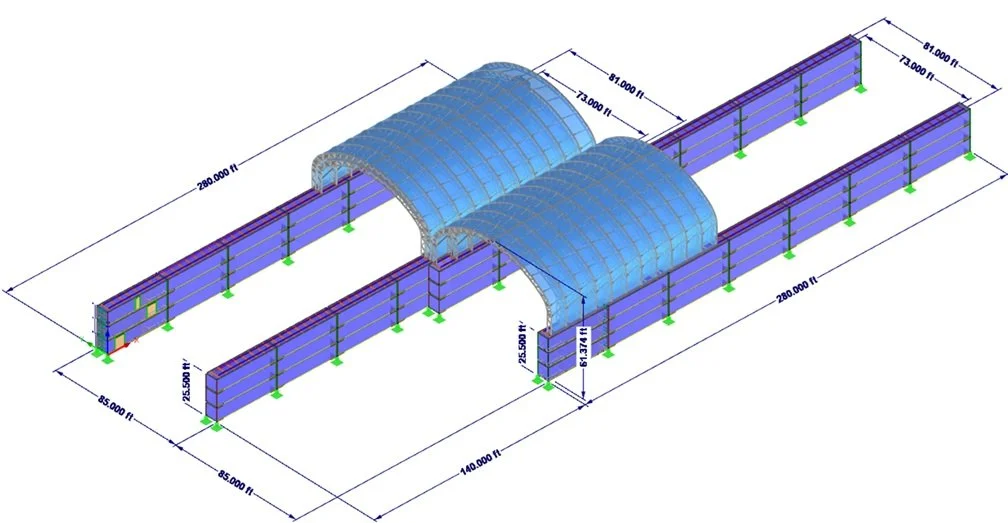
This project reflected exactly that transition.
The structural study moved beyond individual module checks and into system-level coordination. The design incorporated long-span curved roof forms supported by the modular side structures, creating a relationship between enclosure geometry and primary support behavior that had to be carefully modeled. The spacing of supports, stiffness of the side walls, framing continuity, and force transfer between elements all became critical.
In other words, the question was no longer whether the modules worked on their own. The question was whether the entire system worked together.
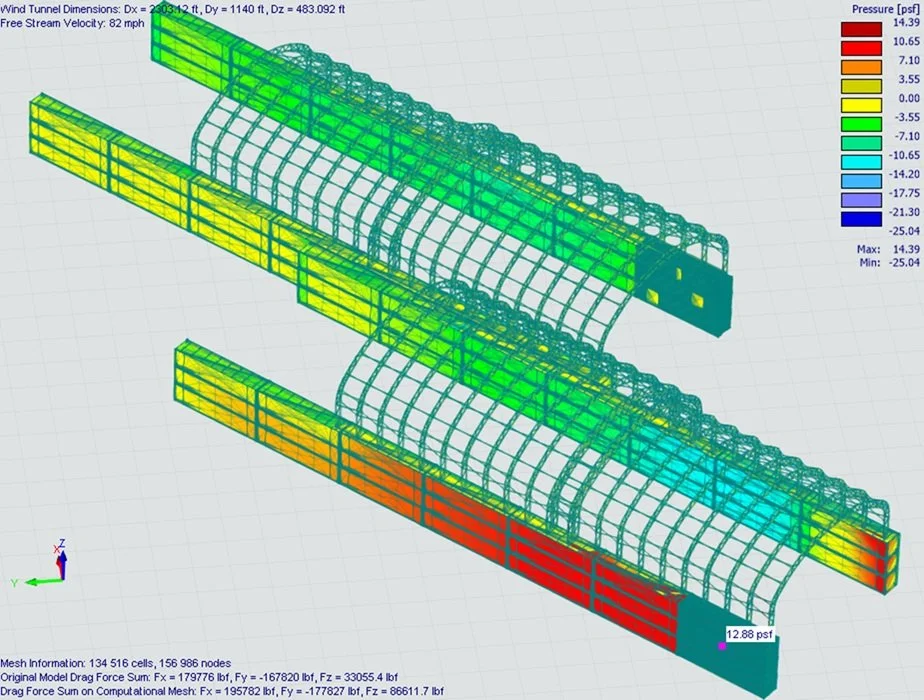
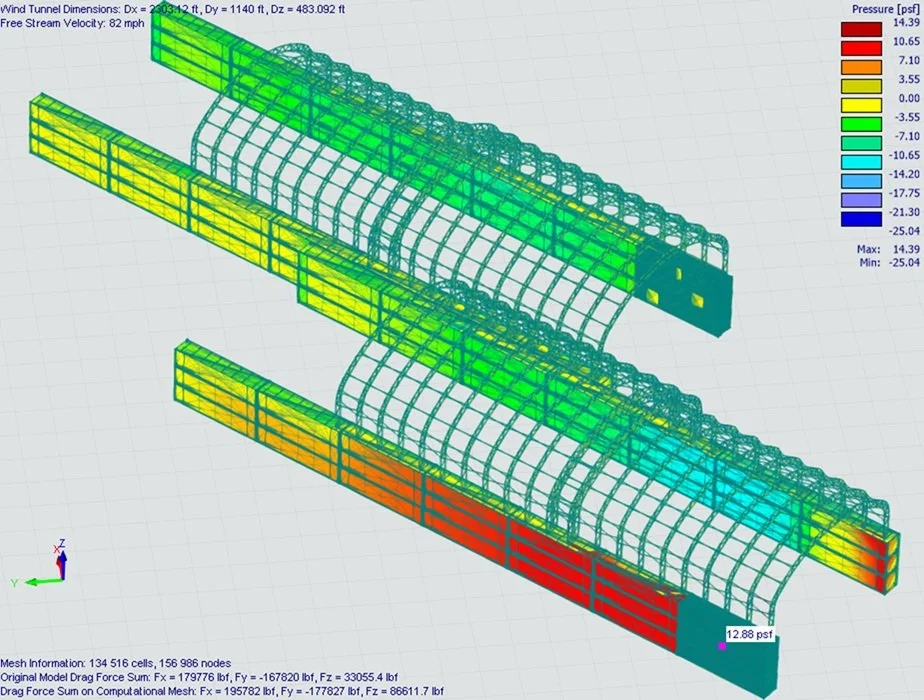
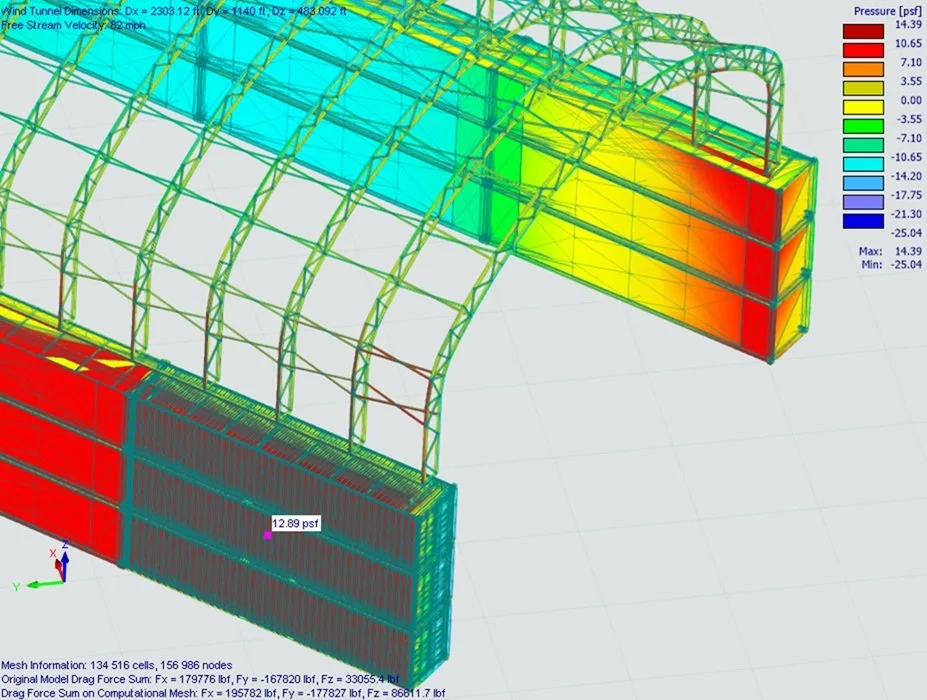
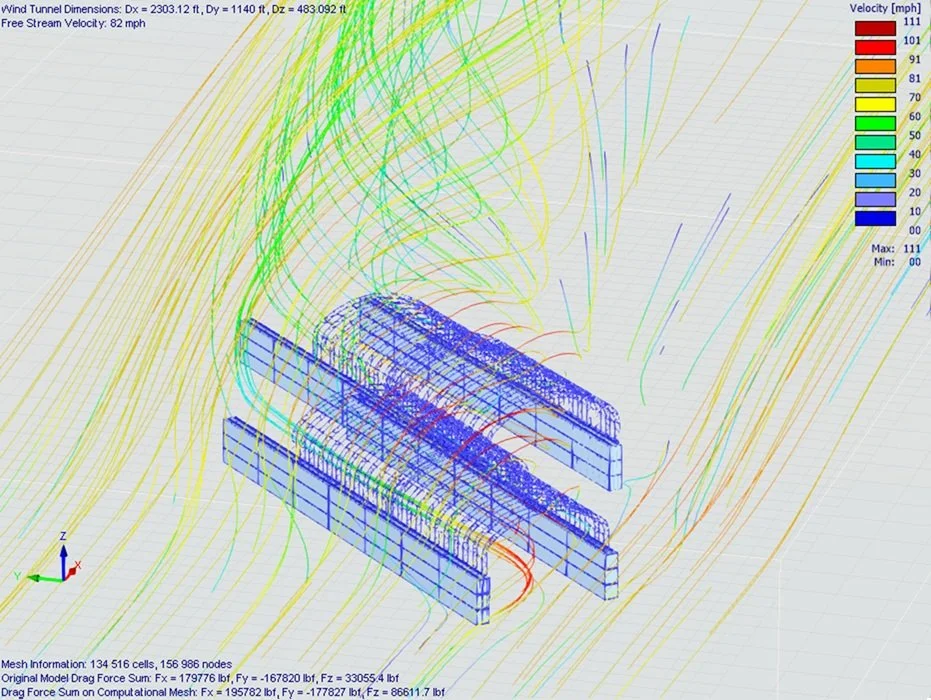
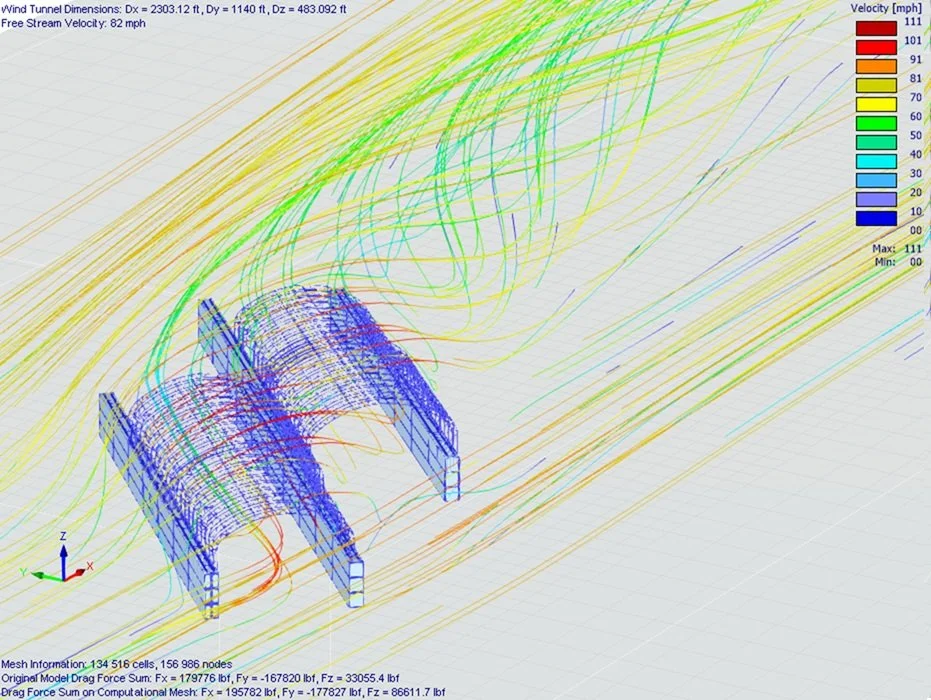
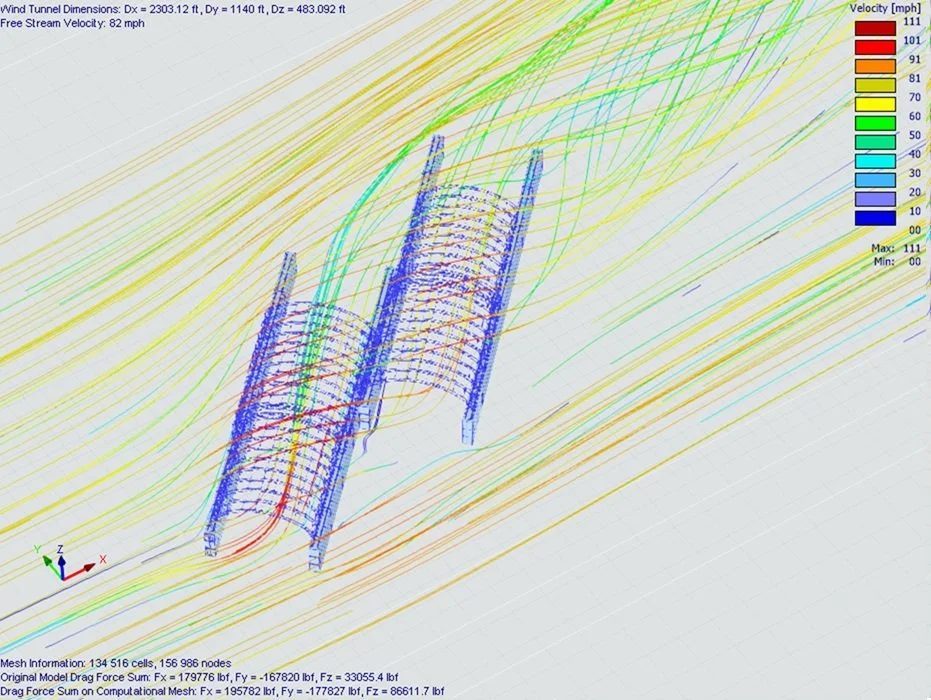
Wind added another important layer. Projects with unusual geometry, long open spans, and partially enclosed forms can behave very differently from conventional box-shaped buildings. For that reason, the engineering effort included detailed wind review supported by computational airflow analysis. Pressure mapping and streamline studies helped illustrate how wind moved around the form, where localized pressures increased, and how the spacing and shape of the structures influenced the overall response.
That kind of analysis is especially useful when a project falls outside the comfort zone of simplified assumptions. It helps turn geometry into something measurable and gives the design team a clearer picture of how the structure may behave under real environmental loading.
What makes this project worth highlighting is the range of coordination it required. The architectural concept, the operational needs, and the structural demands were closely connected. None of them could be solved in isolation. The project needed a design approach that respected modular efficiency while still addressing the realities of custom loading, support conditions, roof geometry, and wind effects.
That balance is where structural consulting becomes most valuable.
The role of engineering in a project like this is not simply to verify what has already been drawn. It is to help shape the path forward — identifying where the concept becomes structurally sensitive, where assumptions need to be tested, and where deeper analysis can create confidence before fabrication and construction move ahead.
This project is a good example of how modular construction can do much more than repeat a standard unit. With the right structural approach, it can support large, specialized environments that combine practicality, adaptability, and ambitious design.
And that is often the most interesting part of the work: helping a modular idea become a structurally coherent building system.