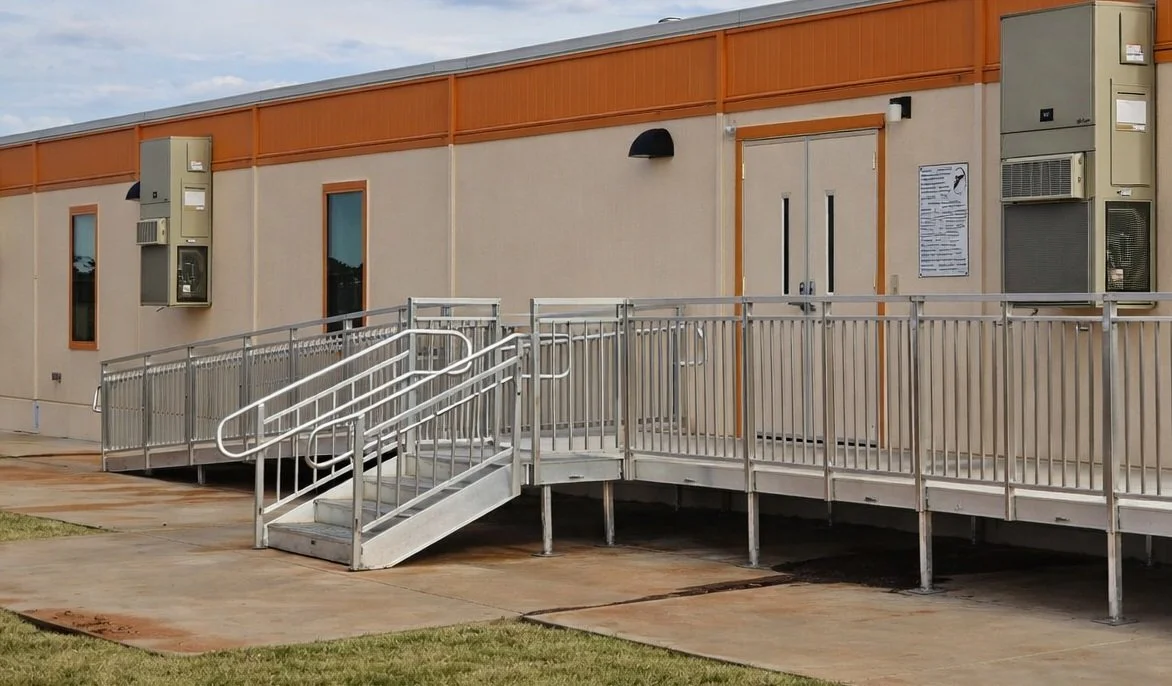
Modular Access Systems

Modular access systems such as ramps, stairs, walkways, and platforms are often sold on speed, adaptability, and ease of installation, but project-specific structural requirements can quickly create delays if not handled efficiently.

MSC deliverables helps access system providers save time, reduce approval friction, and minimize unnecessary coordination through practical engineering support tailored to real project conditions.

We understand the value of time because in this part of the industry, fast response and dependable delivery can directly affect sales, customer confidence, and project execution.

Interested?

Practical structural support for prefabricated ramps, stairs, landings, platforms, and elevated access assemblies

Modular access systems are often selected because they can be fabricated efficiently, installed quickly, and adapted to different site conditions. But even when the system is modular, the structural demands are rarely identical from one project to the next.

Changes in elevation, span, landing size, support spacing, wind exposure, anchorage conditions, and site layout can all change how the system behaves. What appears to be a repeatable access product may still require project-specific structural review once it is placed in a real-world setting.

Why modular access systems need special attention

Access systems do more than provide circulation. They must safely carry gravity loads, remain stable under lateral forces, transfer reactions into supports or foundations, and perform acceptably under service conditions.

This becomes especially important when the project includes:

  • tall ramp runs or elevated platforms

  • multiple landings and switchback layouts

  • stairs with custom support framing

  • walkways connected to existing structures

  • partial cantilevers or irregular support spacing

  • site-specific anchorage or foundation conditions

  • wind-exposed or open-frame installations

In these cases, the structure is not controlled only by one member. It is controlled by how the entire system works together.

Where this structure type is commonly used

Modular access systems are commonly used for:

  • ADA ramps

  • stairs and intermediate landings

  • elevated equipment platforms

  • crossover walkways

  • maintenance access structures

  • industrial and utility access assemblies

  • building entry systems

  • prefabricated circulation structures for modular buildings and site-built facilities

Some are highly repetitive. Others require custom structural adaptation because of the project geometry or support condition.

Projects where structural review especially valuable

Structural review is especially useful for modular access systems with:

  • tall post-supported ramps or stairs

  • elevated landings or long walkway spans

  • custom site grading and variable support heights

  • unusual support or anchorage conditions

  • projects exposed to higher wind demand

  • repeated product layouts adapted to different sites

  • modular building access systems tied to project-specific foundations

A practical fit for access system projects

Modular access systems usually need engineering that is technically disciplined but still practical to apply. Good structural support helps clarify the load path, framing behavior, support demands, and critical connection points without making the system more complicated than it needs to be.

That means focusing on:

  • realistic loading conditions

  • efficient structural layouts

  • serviceable member performance

  • clear support reactions

  • practical anchorage demands

  • communication that fits fast-moving project work

For modular access systems, good engineering support helps turn a repeatable product into a dependable project-specific structure.

Planning a modular access system project?

Share your layout, support condition, and project criteria so the structural scope can be reviewed clearly and efficiently.