
ISO Container Structures

Modular Structural Consultants, LLC (MSC) is one of the very few structural engineering firms in the United States specializing in ISO shipping container building structural design.
Shipping containers are made of strong and durable materials, suitable for building structures. Shipping containers can be repurposed for various building functions in commercial, industrial and military use, including office, storage, workspace, living space, bathrooms and locker rooms, military training facilities, emergency response facilities, equipment enclosure and multi-container buildings.
Interested?
Our Design Capabilities
We offer engineering services for container structure design ensuring innovative solutions tailored to diverse needs. Our team leverages advanced technology, combined with extensive structural engineering knowledge, industry experience, and expertise in container design, to deliver reliable, economical and safe container structures. We design the container buildings according to the US building design codes, including International Building Code (IBC), design loads for building and other structures with ASCE 7, steel design with AISC 360 and AISI S100.
Sneak Peek of Our ISO Container Projects
A quick visual overview of our work with modified shipping containers, custom framing, and project-specific structural solutions.
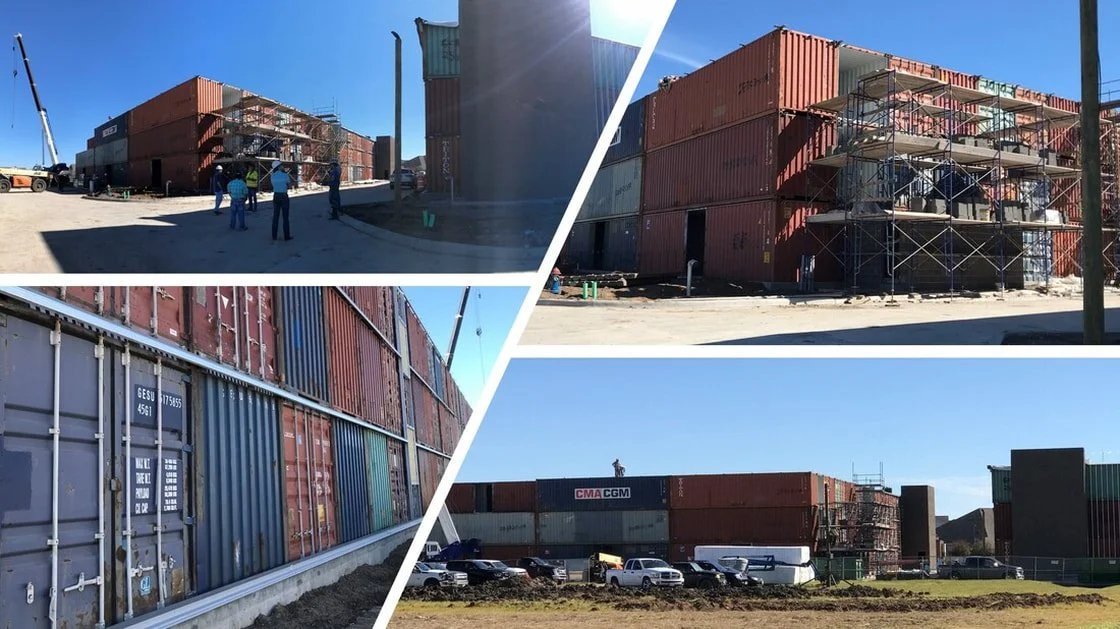
Self-Storage Building made of four hundred 40ft HC container units.
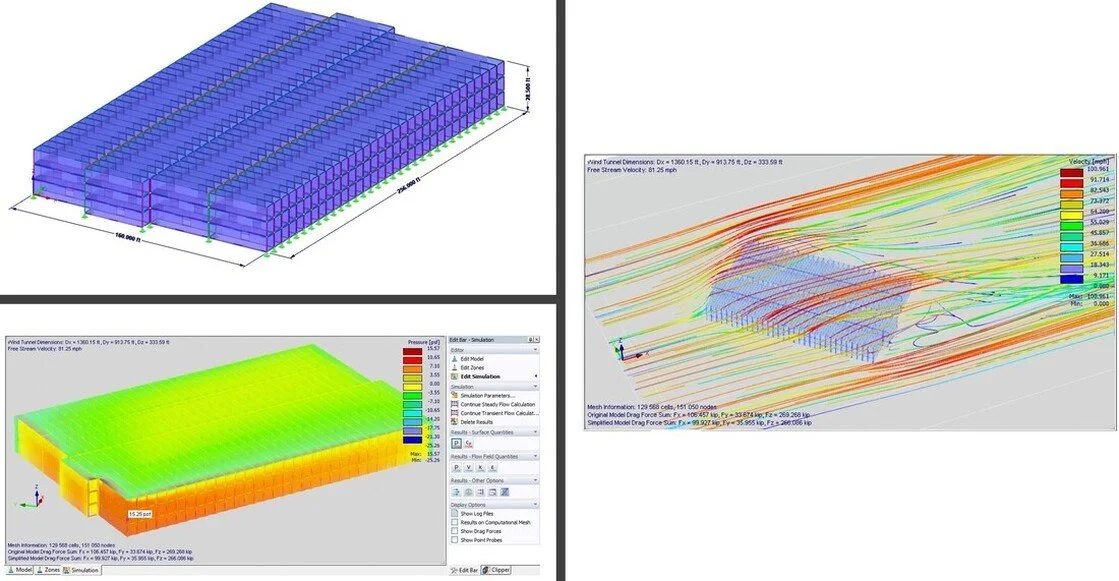
Wind Load Simulation of Self-Storage Building made of four hundreds 40ft HC container units.
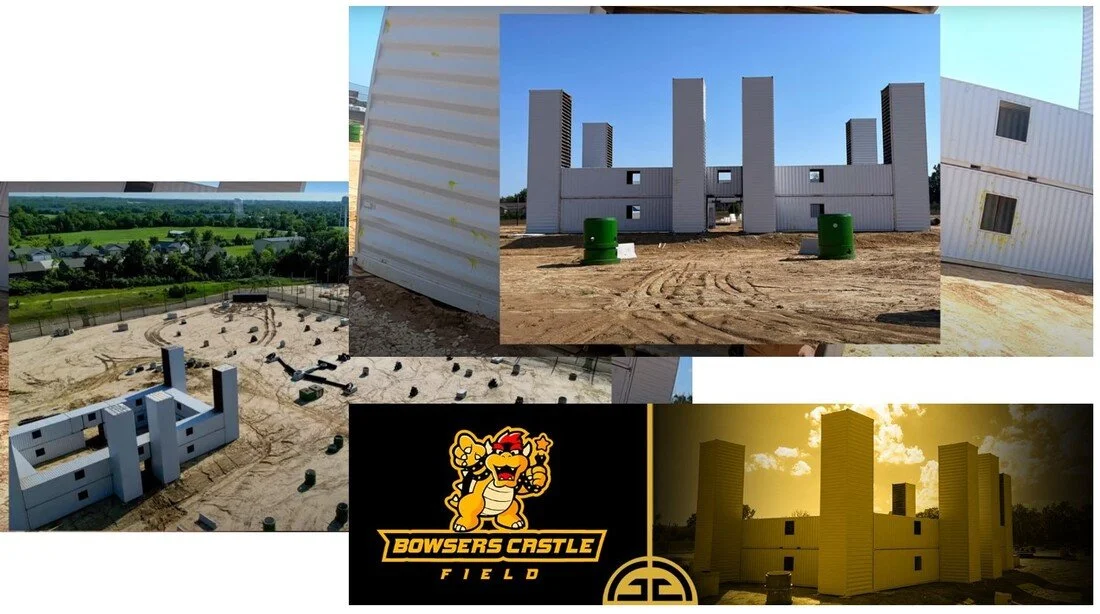
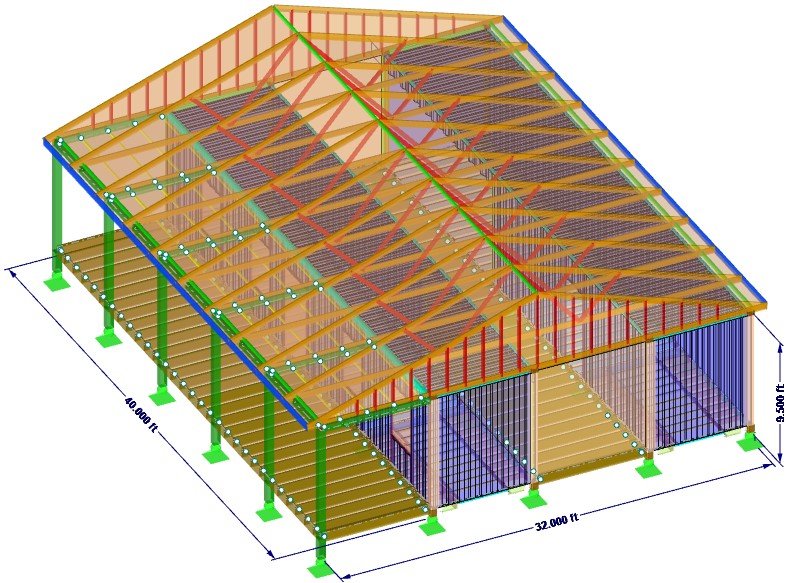
Bowsers Castle Field - Paintball / Airsoft Recreation Destination https://ggsportspark.com/good-game-sports-park-maps-and-playing-fields/
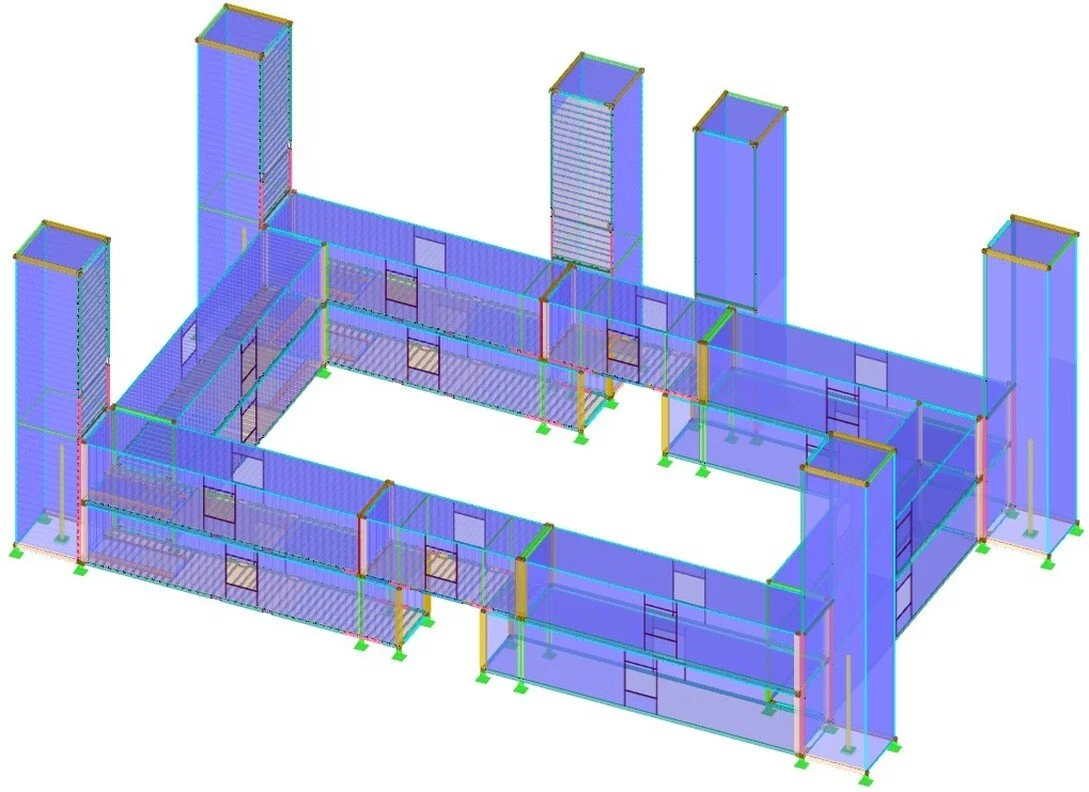
Finite element modelling of Bowser Castle Field Project
Stress Analysis of of Bowser Castle Field Project
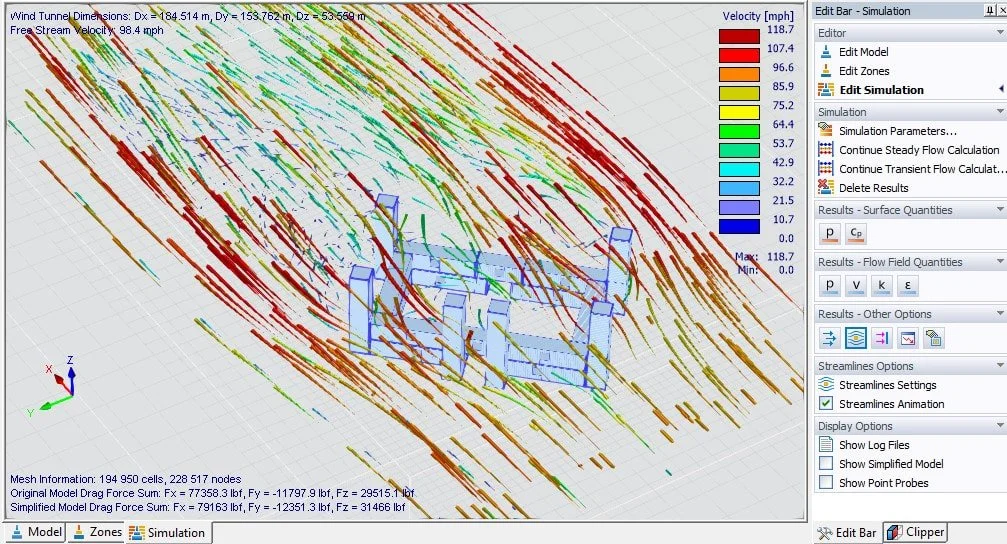
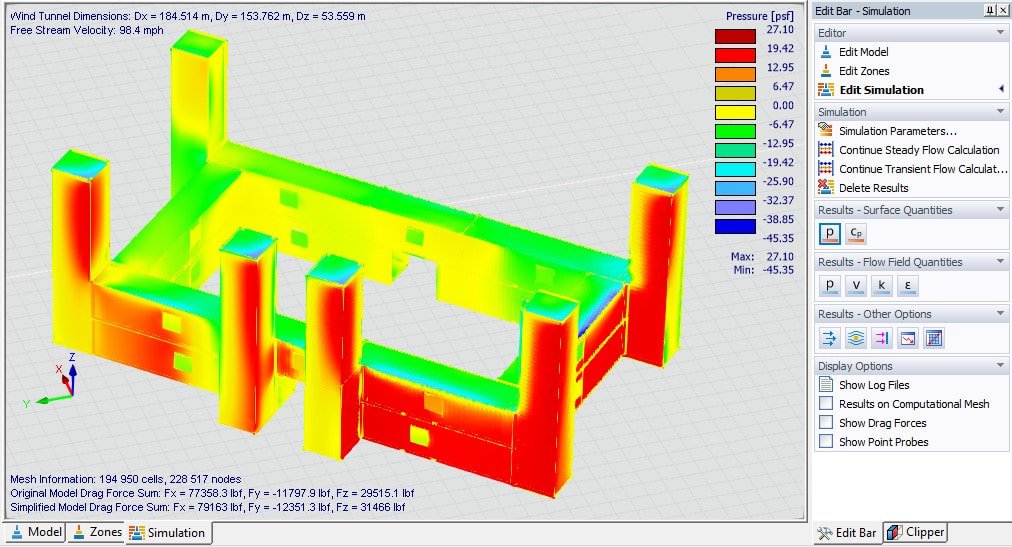
Wind Tunnel Simulation for Wind Load Analysis of Bowser Castle Field Project
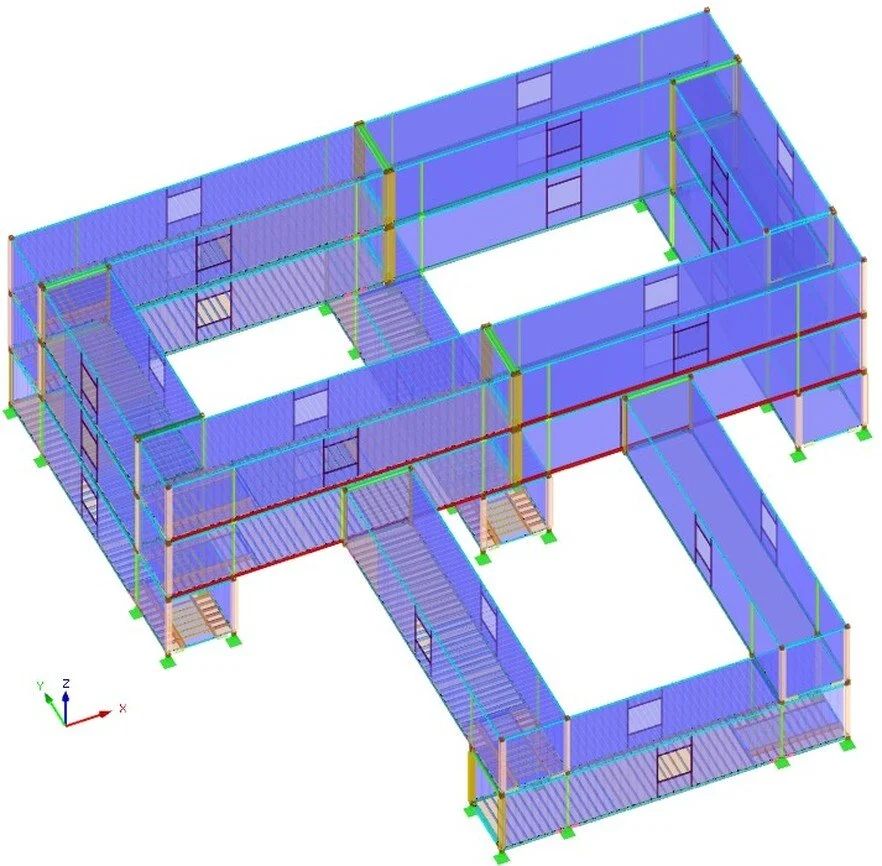
Finite element modelling of Bowser Castle Field Project Part 2
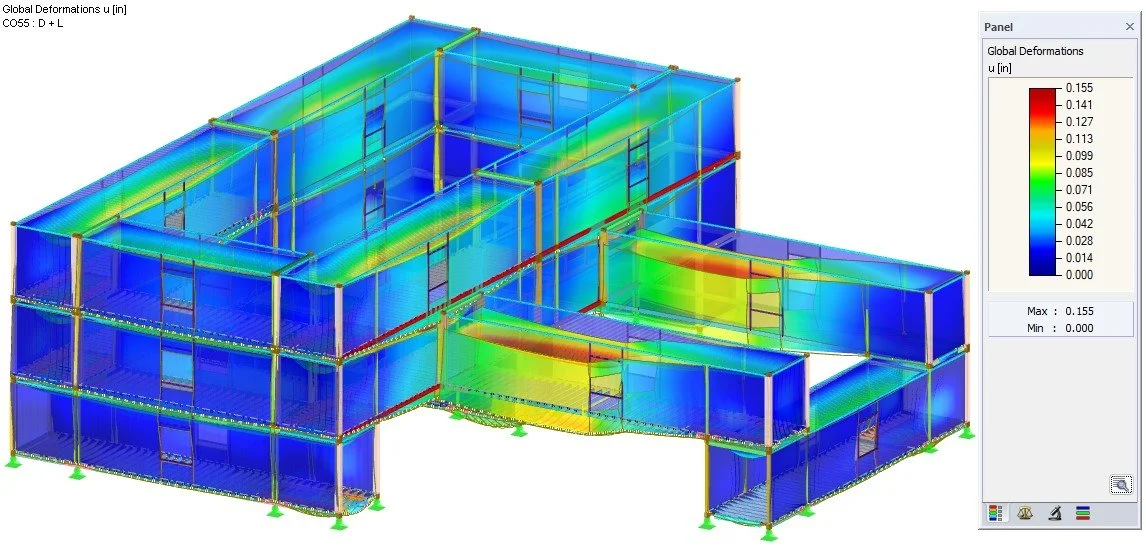
Stress Analysis of of Bowser Castle Field Project Part 2
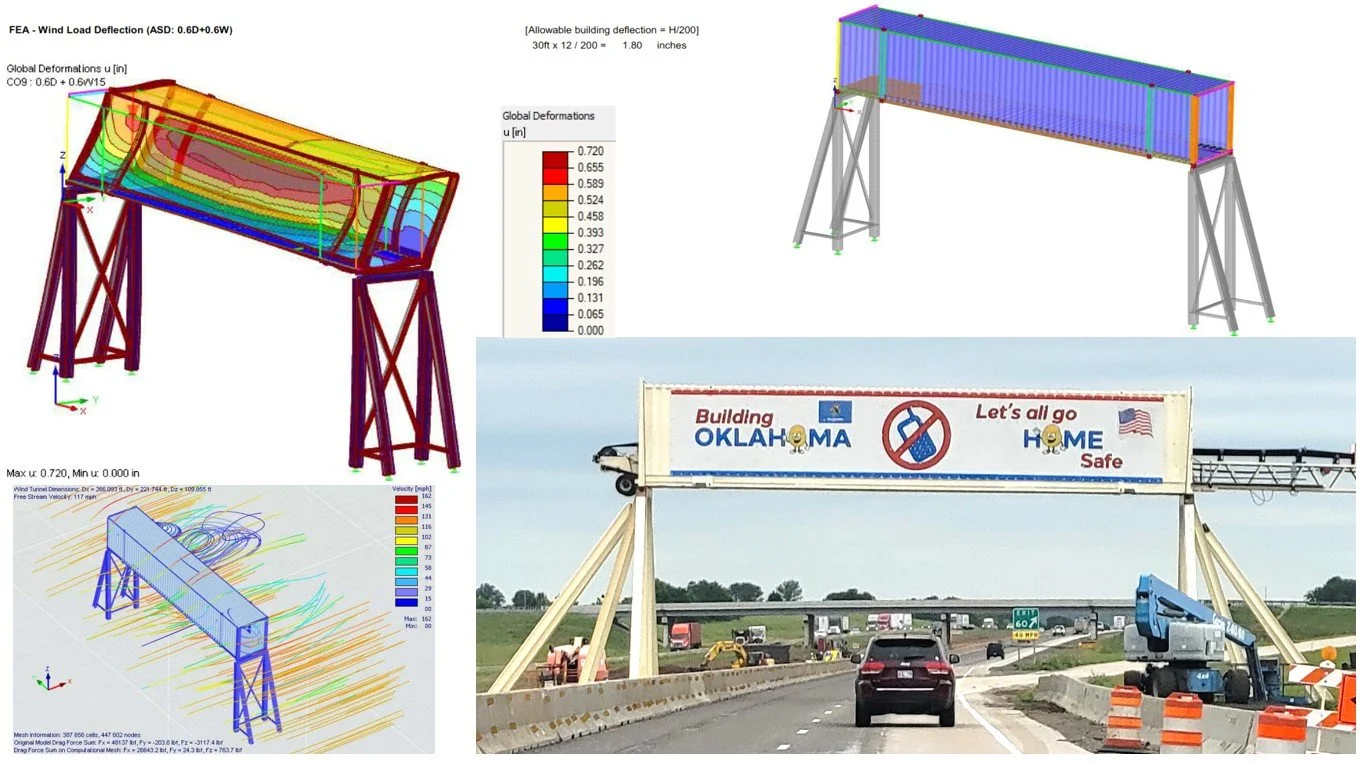
53ft Conveyor Bridge Over an Interstate Highway
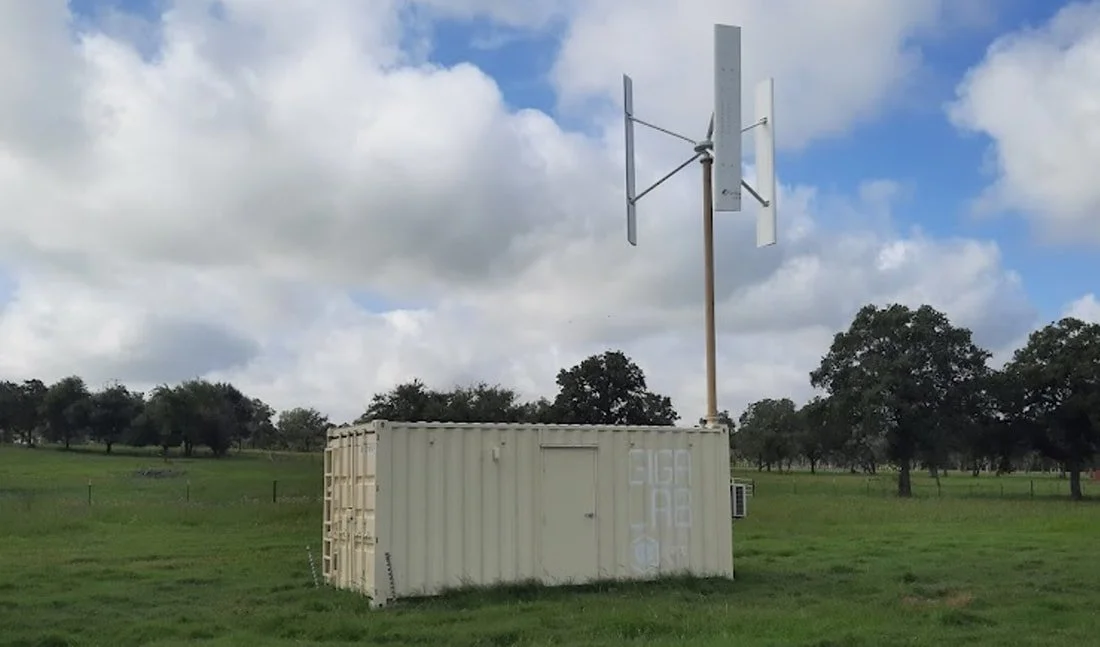
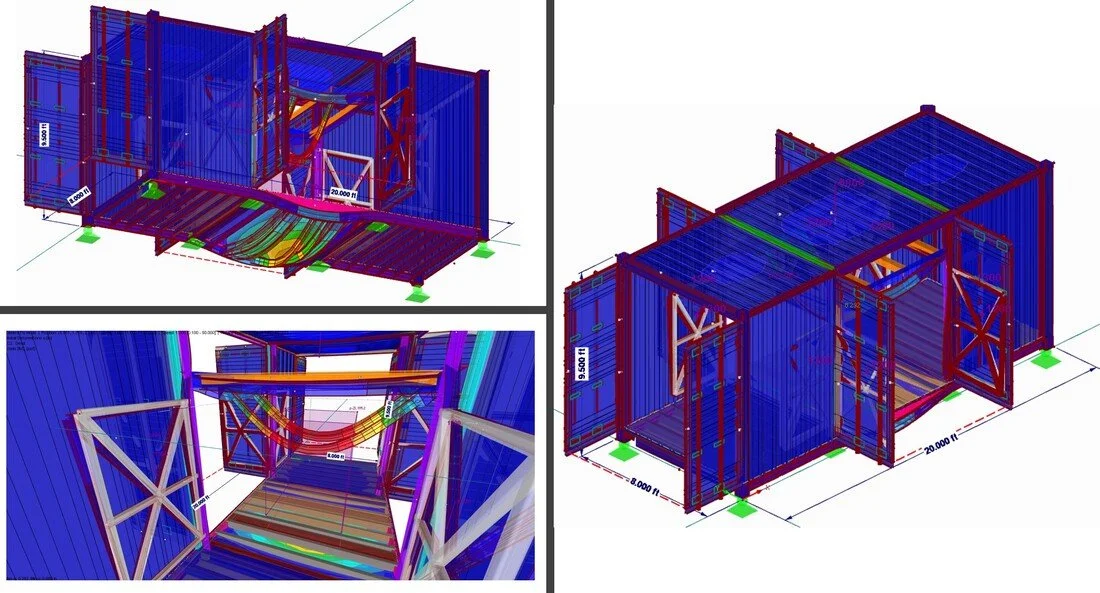
20ft Container with Wind Turbine Masts
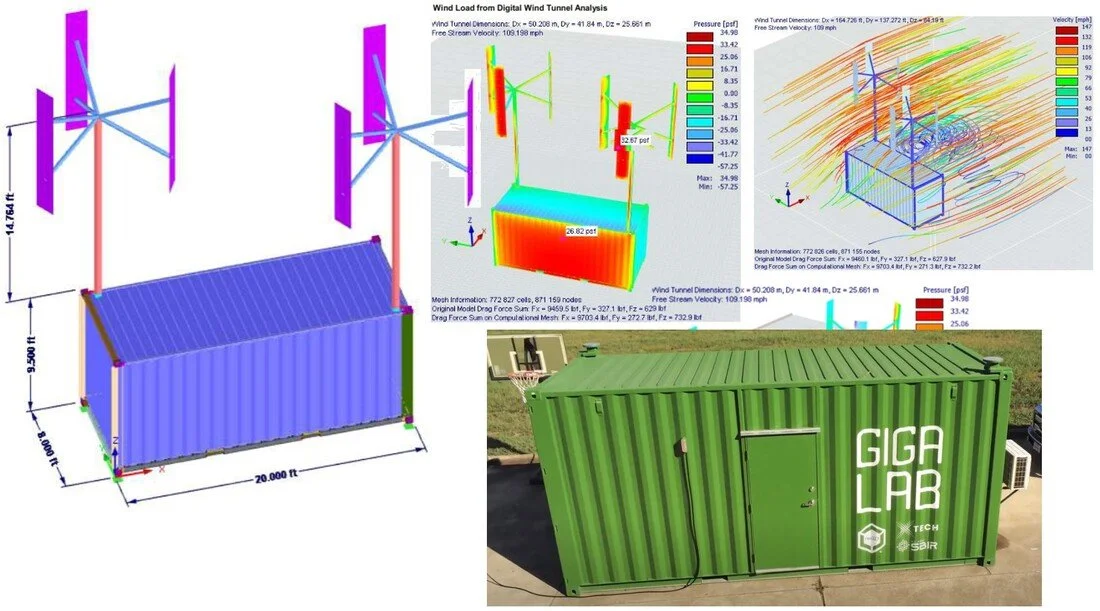
Wind Load and Stress Analysis of 20ft Container with Wind Turbine Masts
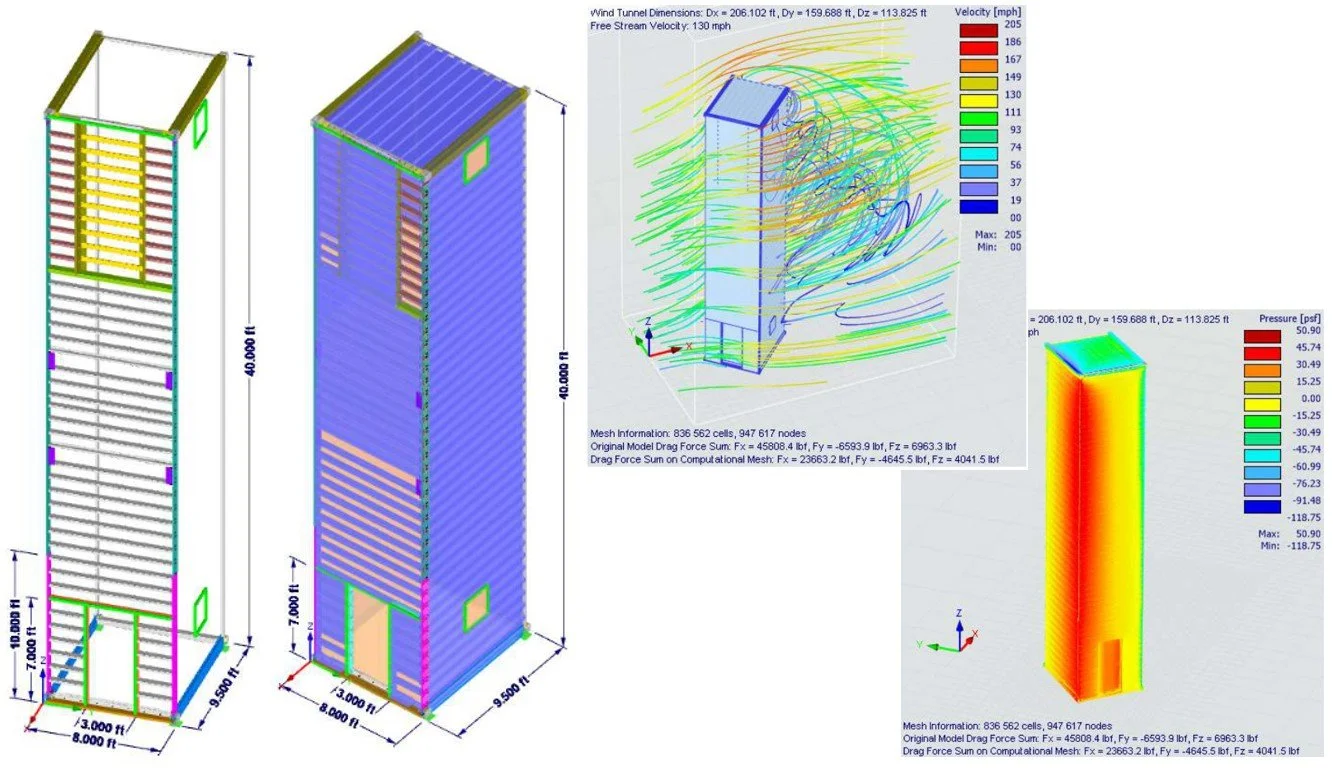
40ft Stand Alone Container Tower Wind Load and Stress Analysis
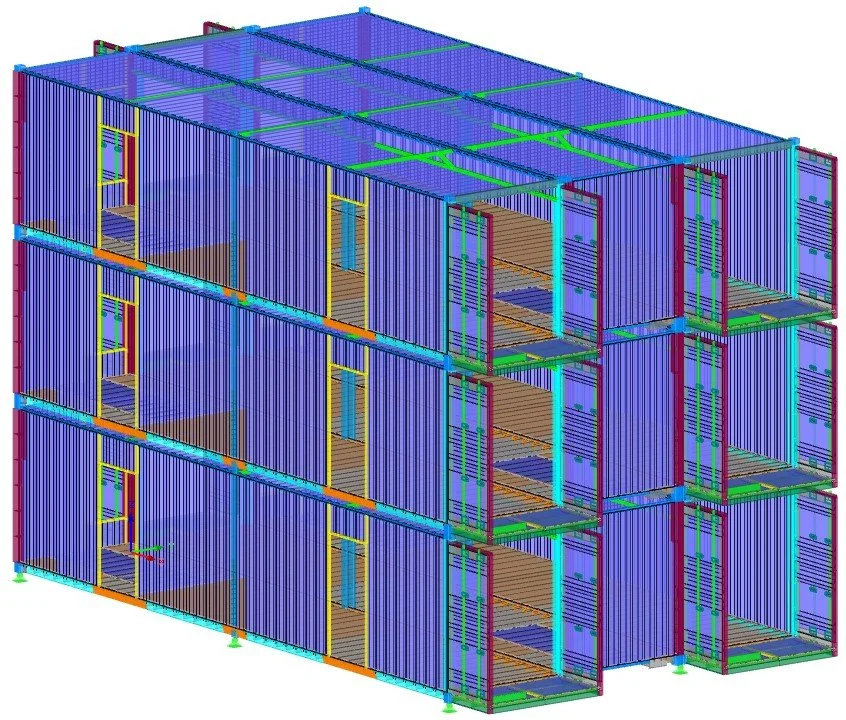
Multi-story Container Building
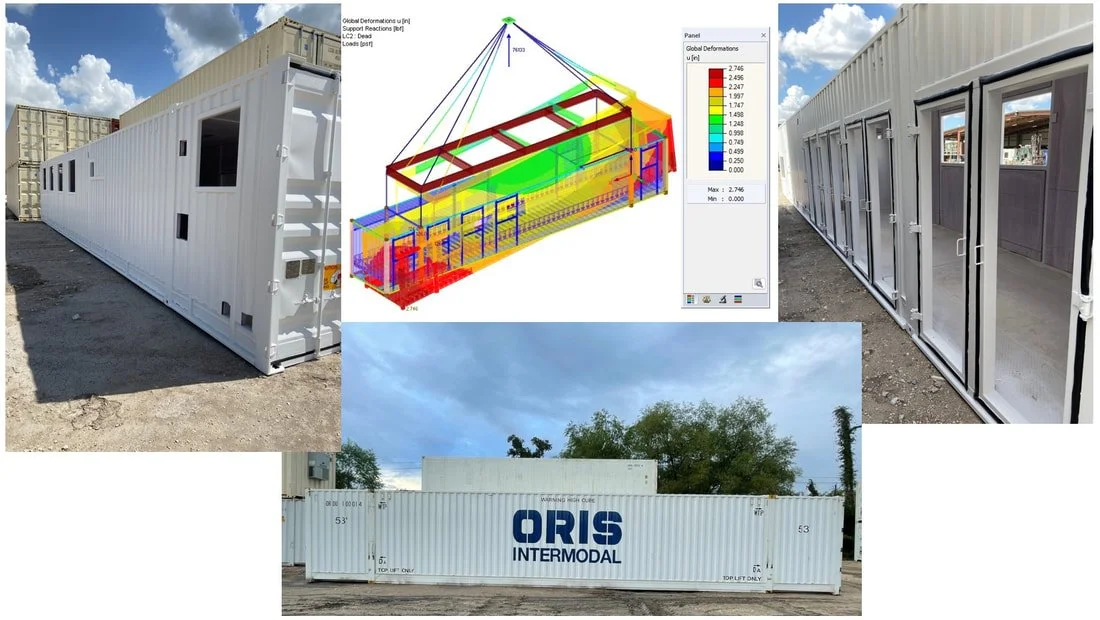
Container Lifting Analysis
Why ISO Shipping Containers Are Structurally Unique
ISO Shipping Containers are constructed in accordance with the International Standard ISO 1496-1, which mandates rigorous structural design requirements. These containers must withstand a payload of approximately 63,000 pounds, equivalent to a uniform floor load of around 200 pounds per square foot. The payload is supported by the container's framing system, which spans from 20 to 40 feet without intermediate supports. Designed for stacking up to eight high, all loads are channeled to and carried by the four corner posts.
A shipping container, also known as an intermodal container, is a standardized container designed for transportation of goods by multiple modes of transportation, such as ocean freights (ships), rail transport (trains) and road transport (trucks). Shipping containers must withstand transportation loads in harsh open ocean weather conditions for extended periods. On the deck of a cargo vessel, they are exposed to high winds and significant horizontal loads generated by the vessel's rocking motions at sea. Notably, most US shipping containers originate from overseas and typically make a one-way trip. Afterward, these "fully tested" shipping containers are sold and repurposed for alternative uses, such as building construction.
Container Computer Model
Shipping container structural members, wall and roof panels are made of high strength COR-TEN steel. The floor cross members, container side rails, beam headers and corner posts are made of various cross sections, some of them are in unique shapes. Side walls, front wall and roof are made of corrugated metal sheets in different shape profiles and thicknesses. Therefore, creating a computer model for container structure is the most challenging aspect in structural analysis. Most structural engineers adopt a design approach using equivalent cross sections by simplifying the geometries, also sometimes by omitting the panels' contribution as structural elements.
Modular Structural Consultants takes a different design approach. MSC has developed a high definition Finite Element Model (FEM) for container structure design. This advanced simulation technique enables more accurate results, detailed analysis of localized effects, simulation of complex behaviors, and optimization of designs. We created finite element models that closely mirror the actual geometries, thicknesses, cross section shapes of shipping container elements. Our finite element model is sophisticated yet versatile to adapt for building openings and structural modifications. We use digital wind tunnel software for generating wind loads for multi-container building with creative configurations, with or without roofs and parapets, All of these design approaches yield more accurate design and analysis results, benefiting our clients with economical and safe container structural designs.
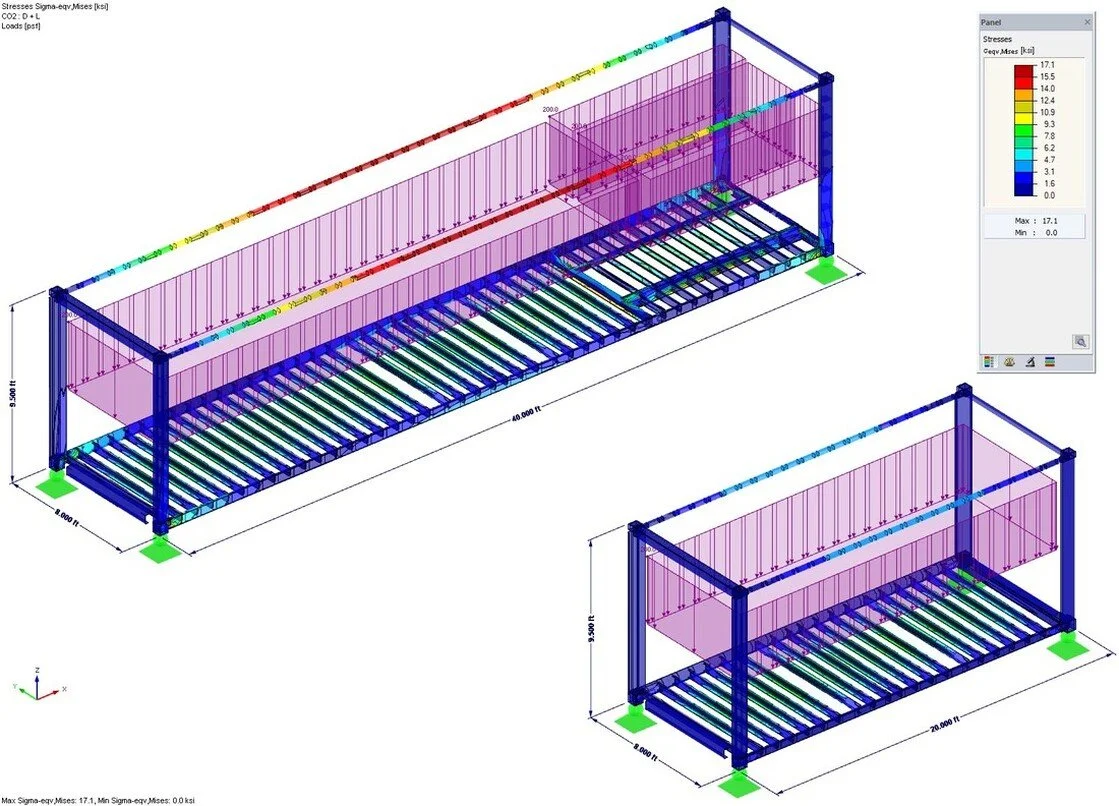
FEM Result Validation - 40 ft and 20 ft Containers, Member Stresses Under Fully Loaded ~ 200 psf floor load.
ISO 1496-1 (6.2.2) Allowable stacking load for 1.8g = 17.1 ksi x 1.8 = 30.78 ksi.
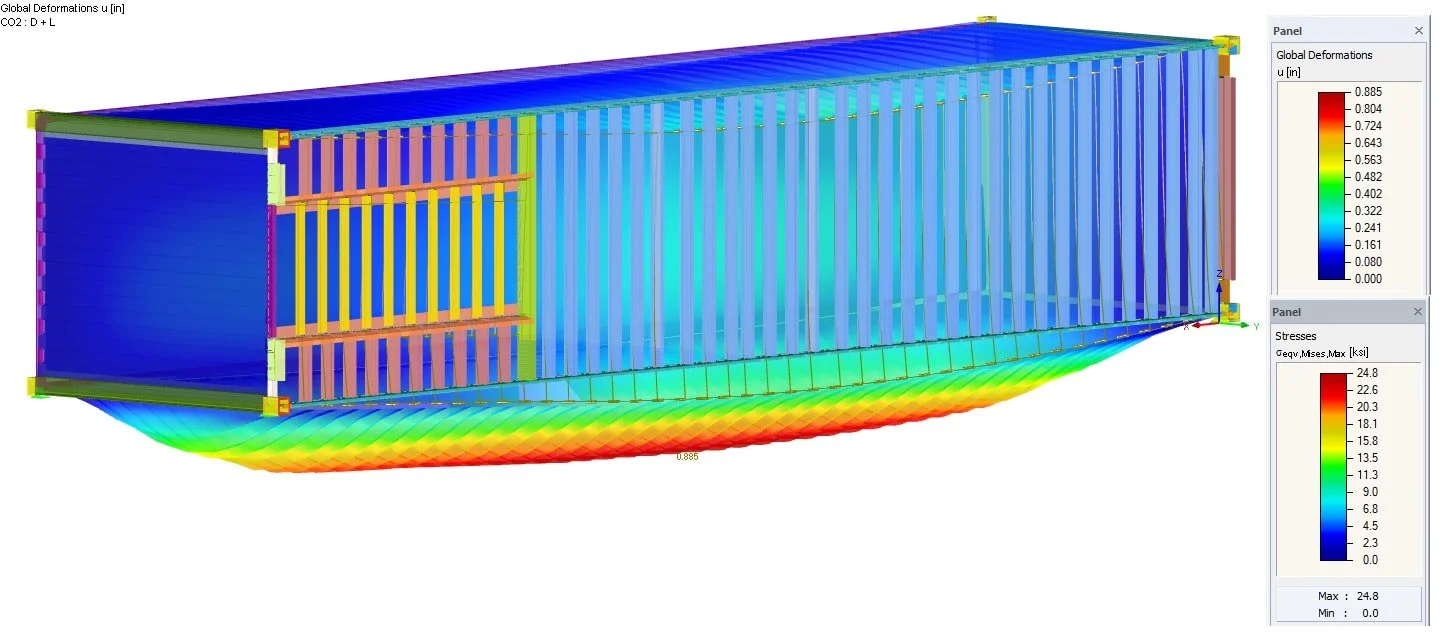
FEM Result Validation - ISO 1496-1 (6.7.2) Side Loading 0.6 Pg ~ 108 psf side pressure
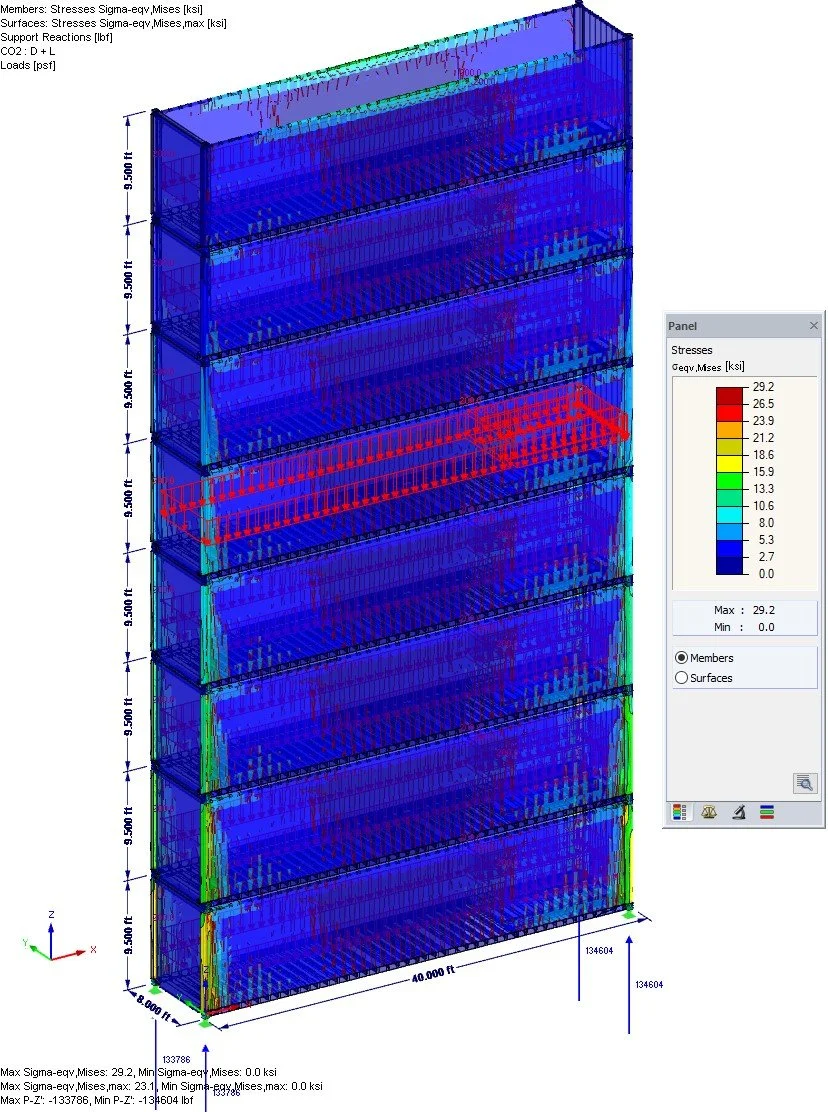
FEM Result Validation - 8 Stack Containers Under Fully Loaded 200 psf at every container.
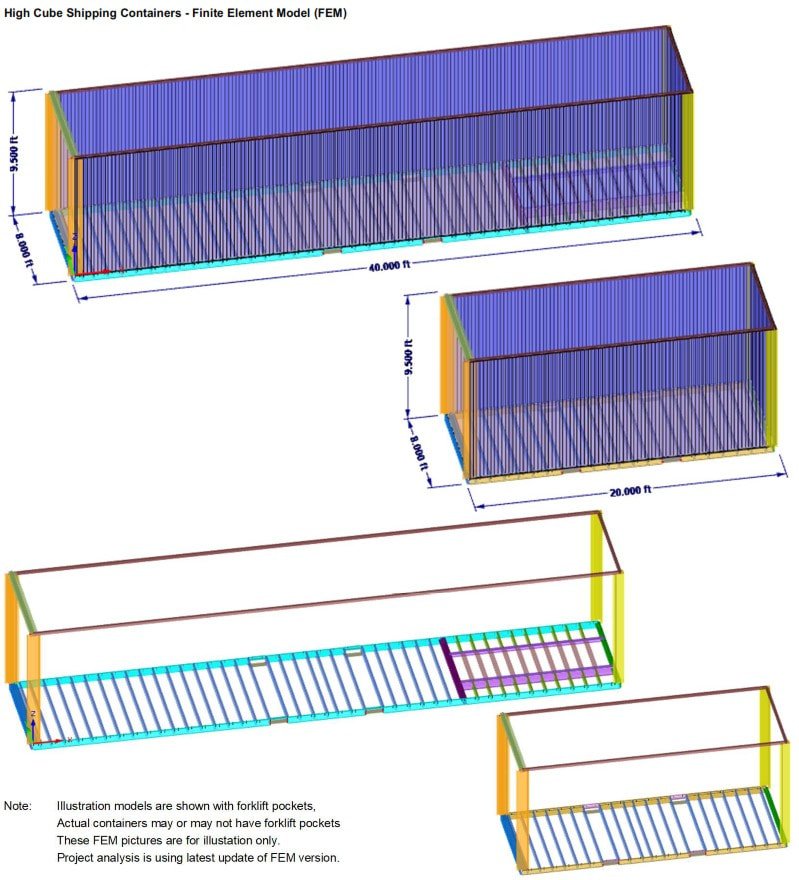
Finite element modelling of 40 ft and 20 ft Shipping Containers
Container Industry Nomenclature
Understanding container industry nomenclature is important when evaluating ISO container structures for modification, analysis, and design. A shipping container is made up of a series of interconnected structural components, each with a specific role in carrying load and maintaining the overall integrity of the unit. These include the corner posts, corner fittings, top side rails, bottom side rails, front header, door header, door sill, cross members, roof panel, side panels, front panel, and floor system.
In original shipping service, these elements work together as a complete structural system. The corner posts and corner fittings are especially critical because they transfer stacking and lifting forces, while the side rails, end frames, and cross members help distribute floor, wall, and roof loads throughout the container. The corrugated wall and roof panels also contribute to stiffness and overall structural behavior.
When containers are modified for building use, understanding this terminology becomes even more important. Removing wall sections, adding doors or windows, changing support locations, or introducing new framing can directly affect the original load path. Clear knowledge of container components helps identify which parts are structurally significant, where reinforcement may be needed, and how the modified container should be analyzed for safe and practical use.
Did You Know?
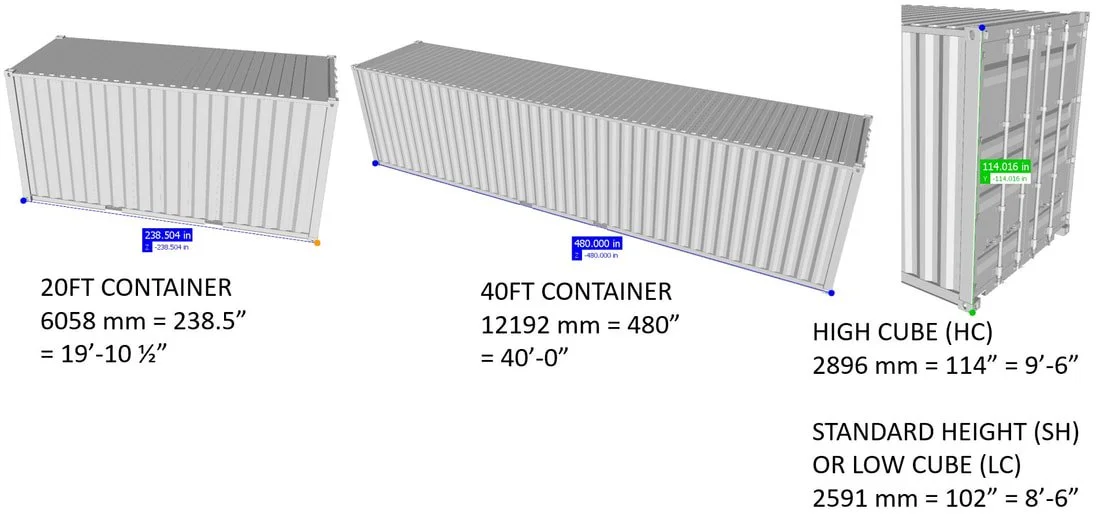
There are two common container heights: High Cube (HC) at 9'-6" total height and Standard Height (SH) at 8'-6" total height.
The 40ft container total length is 40'-0". However, the 20ft container total length is 19'-10 1/2".
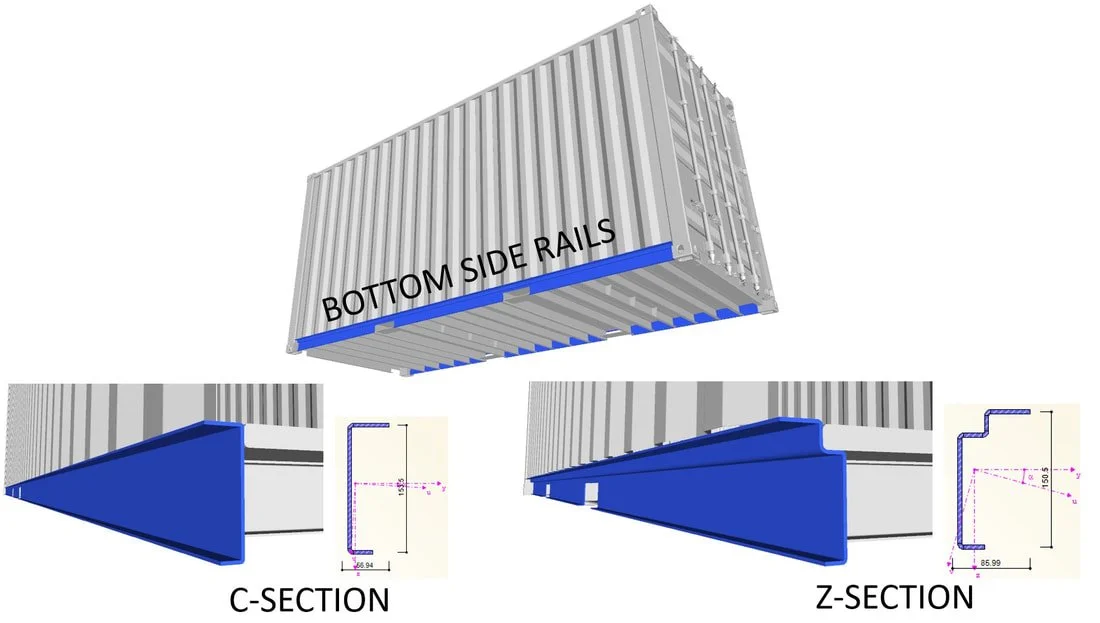
There are two kind of shapes for the bottom side rails: C-Section and Z-Section.
The C-Section is more commonly seen on 40ft containers. Based on observation, newer 40ft containers are increasingly made with Z-Section bottom rails. In contrast, 20ft containers are almost always made with Z-Section bottom rails, and it's rare to see, if any, a 20ft container with C-Section bottom rails.
Buckling Analysis
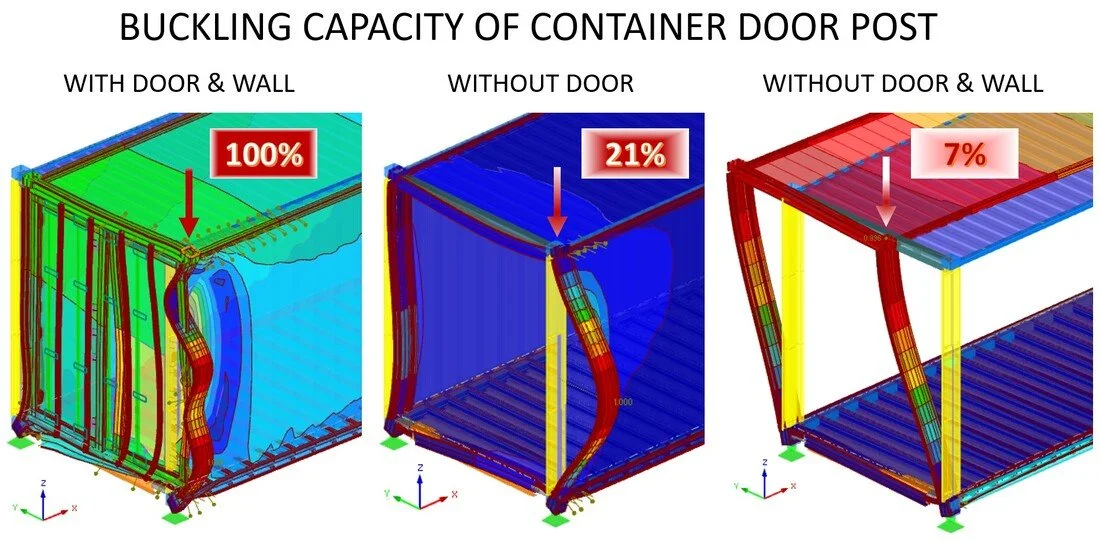
Buckling Analysis of Container Door Post
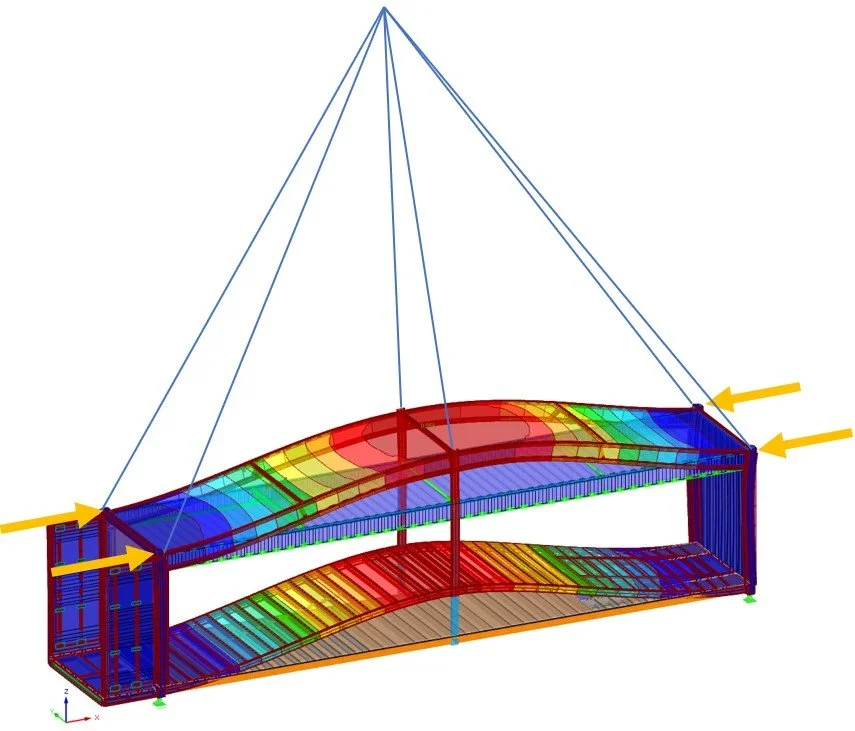
Top Rail Buckling Analysis for Container Lifting
In engineering, buckling failure occurs when a structural member undergoes sudden collapse under high compression loads, despite the actual load being lower than the material's ultimate capacity. The buckling capacity of a structural member is influenced by various factors, including cross-sectional shape and size, member length and slenderness ratio, material properties, loading conditions and boundary conditions, making buckling analysis a complex topic.
Accurate determination of buckling capacity is crucial when designing container buildings and performing container lifting analysis. In ISO container structures, buckling failure can occur at door posts, front corner posts and any reinforcement posts in between. During container lifting with angled cables, the top rail may experience high compression forces.
What makes us special? our design sketches
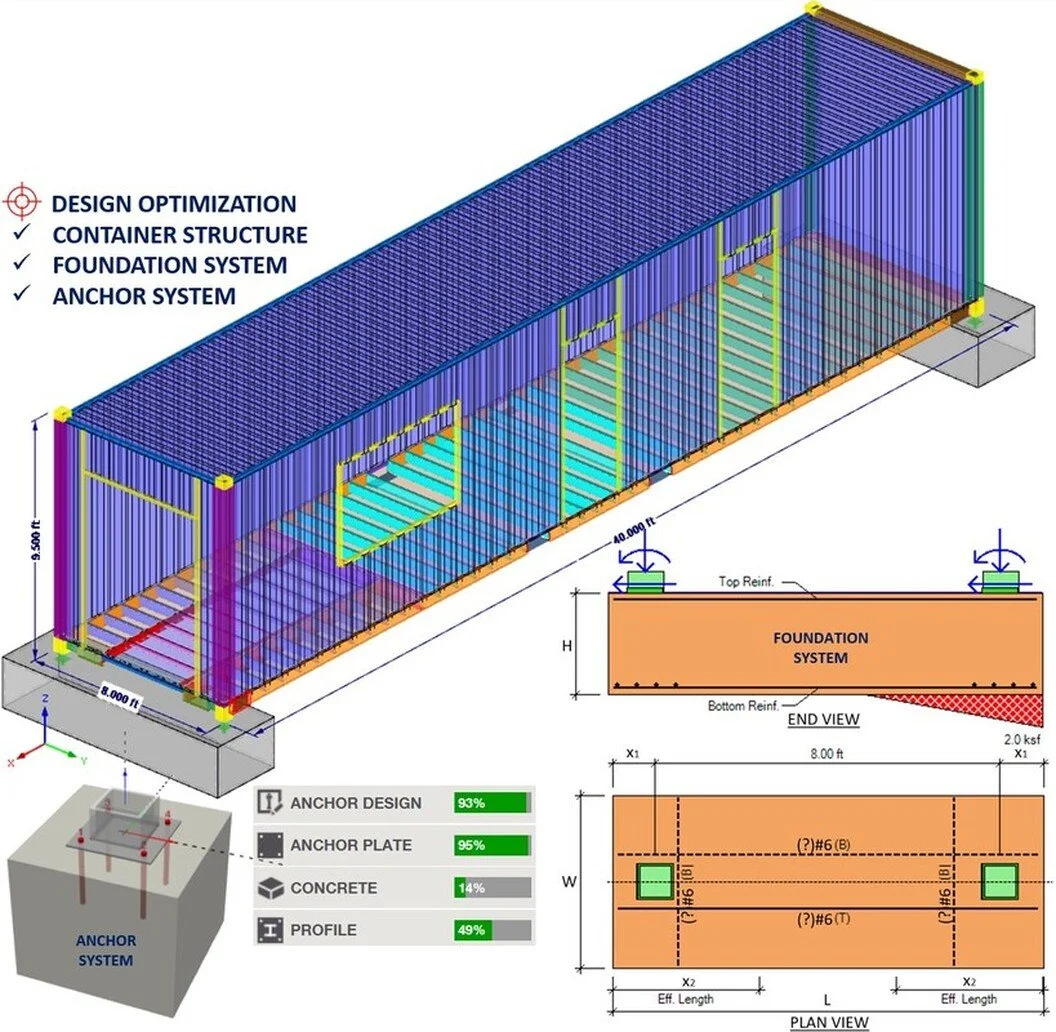
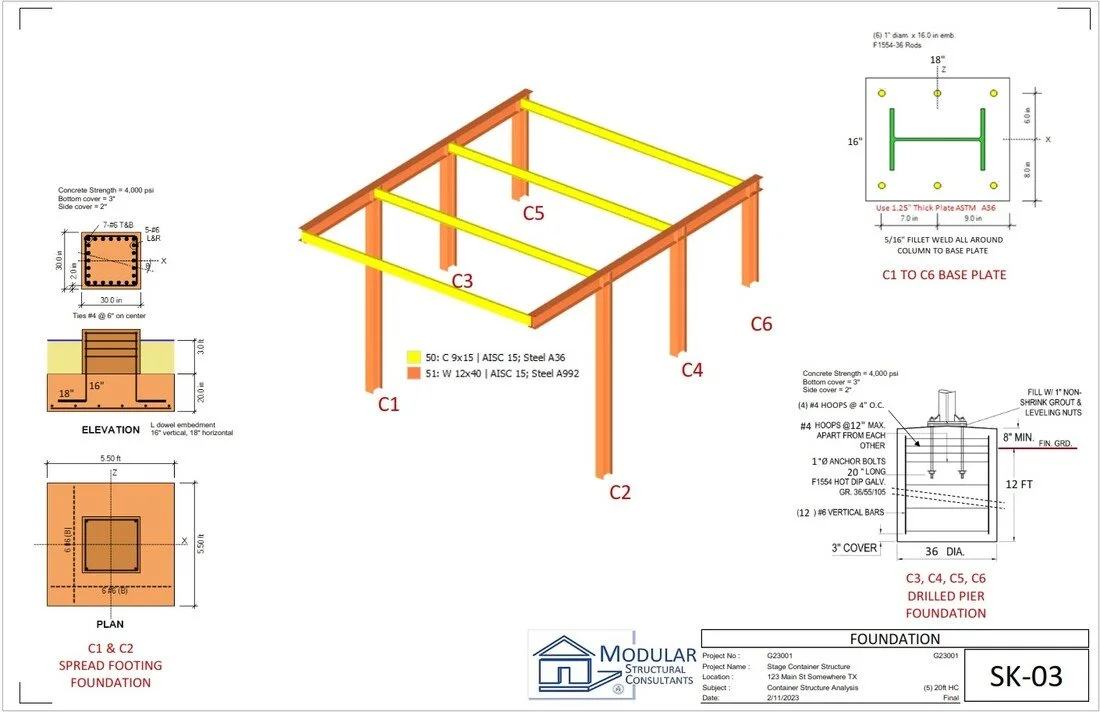
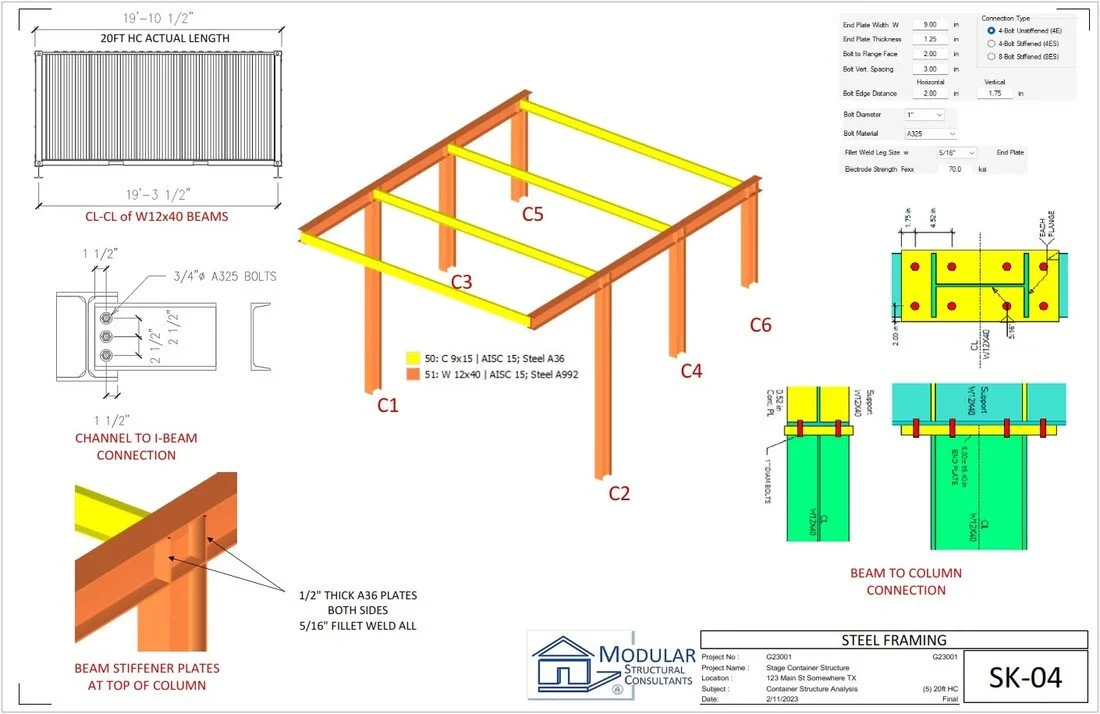
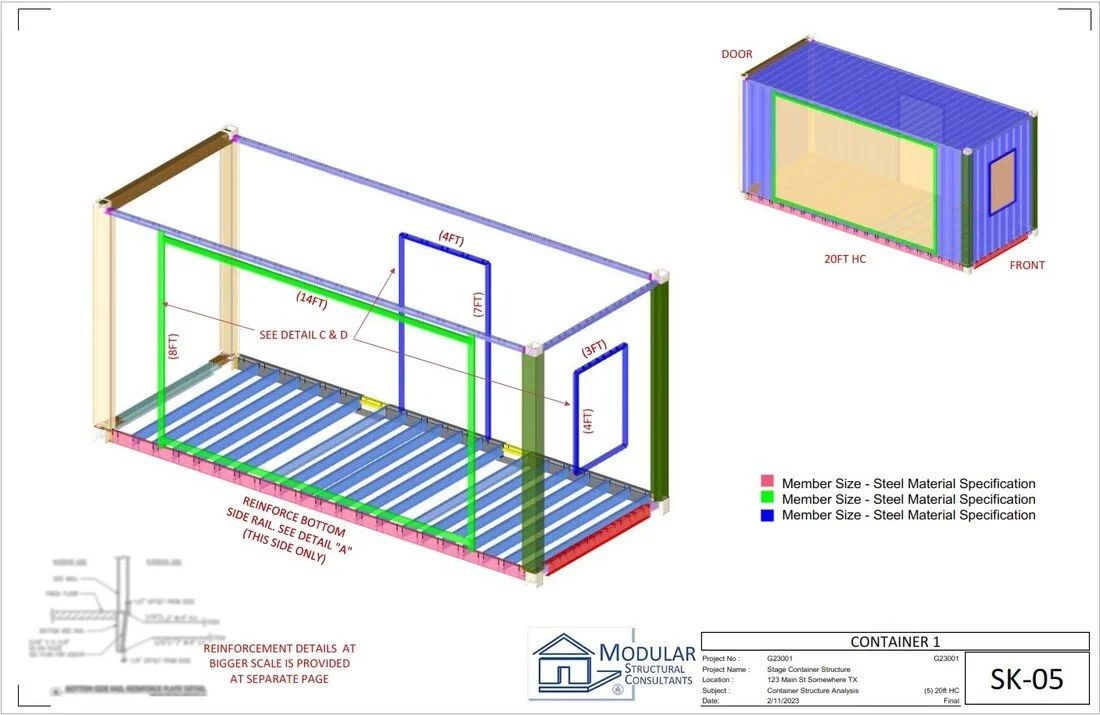
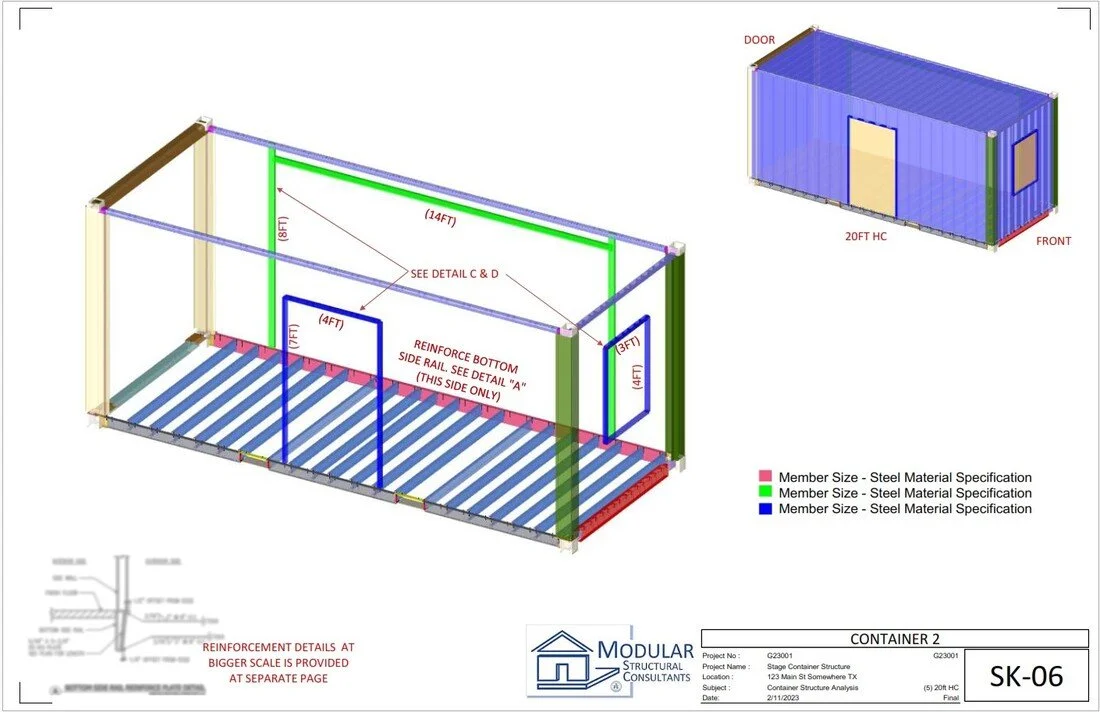
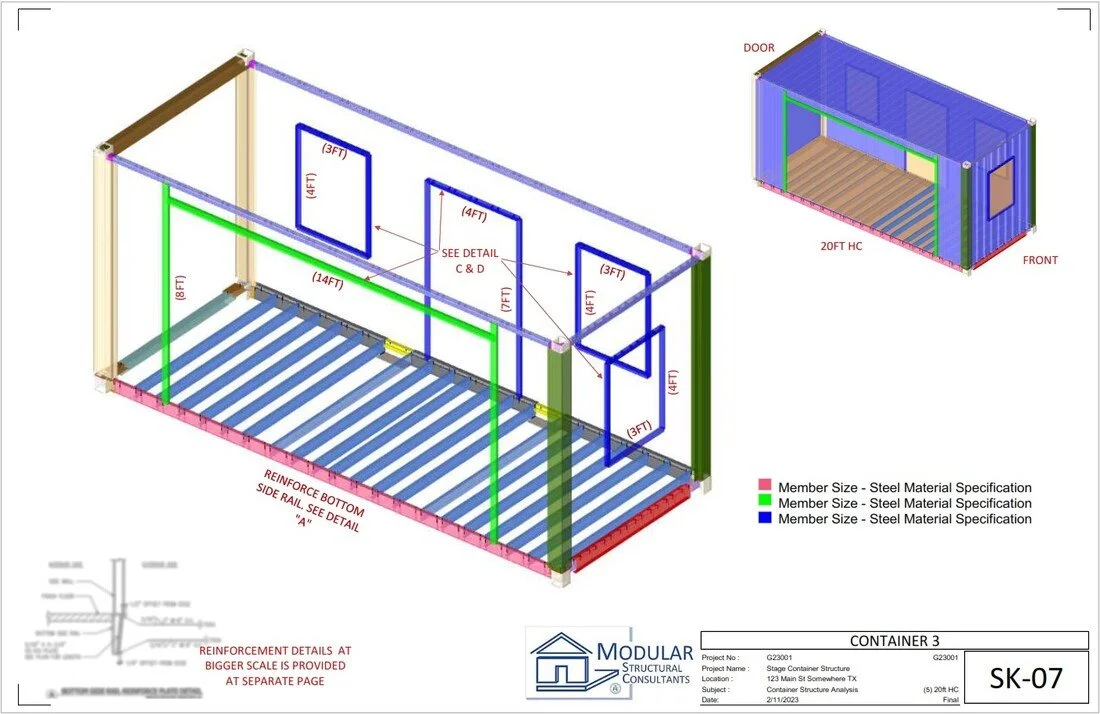
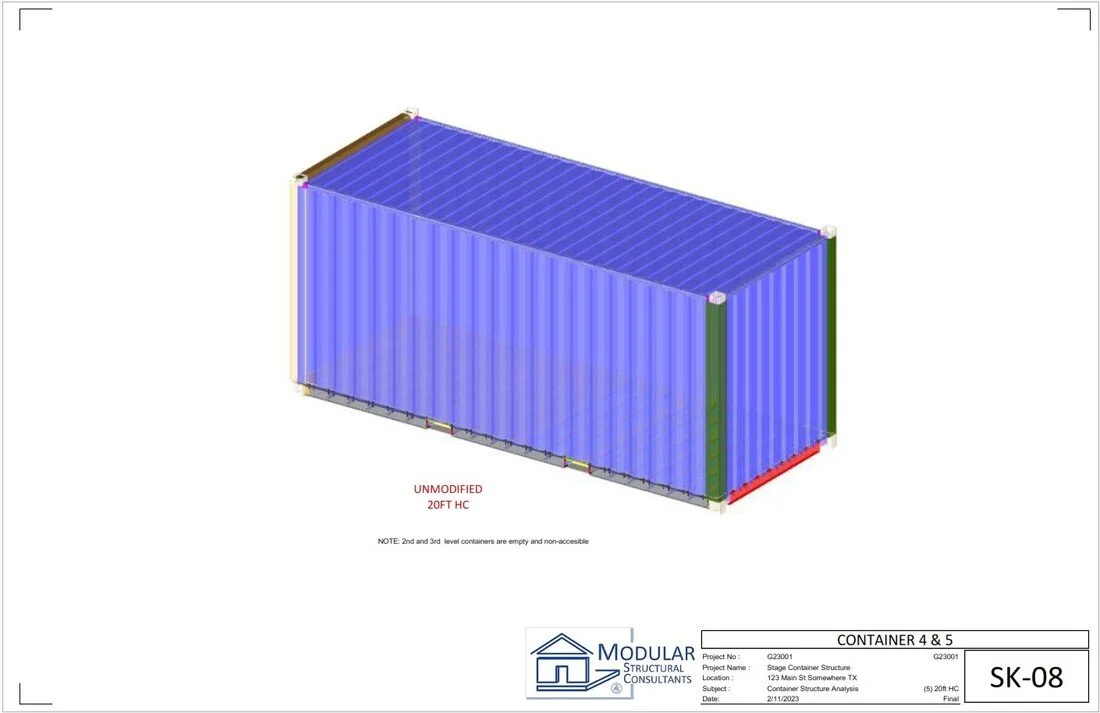
We produce design sketches along with our engineering reports. We understand that most of our clients are not engineers, therefore we make an extra effort to create design sketches to summarize the design and analysis results into a format that easy to understand. Below are example of our design sketches from one of our actual projects
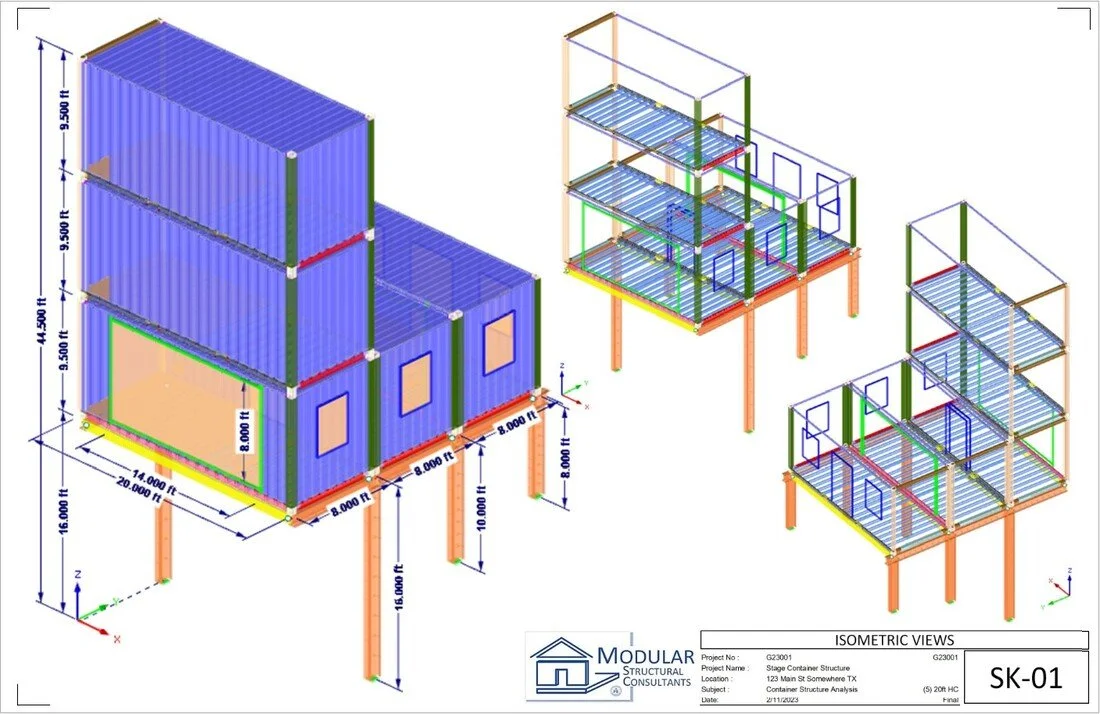
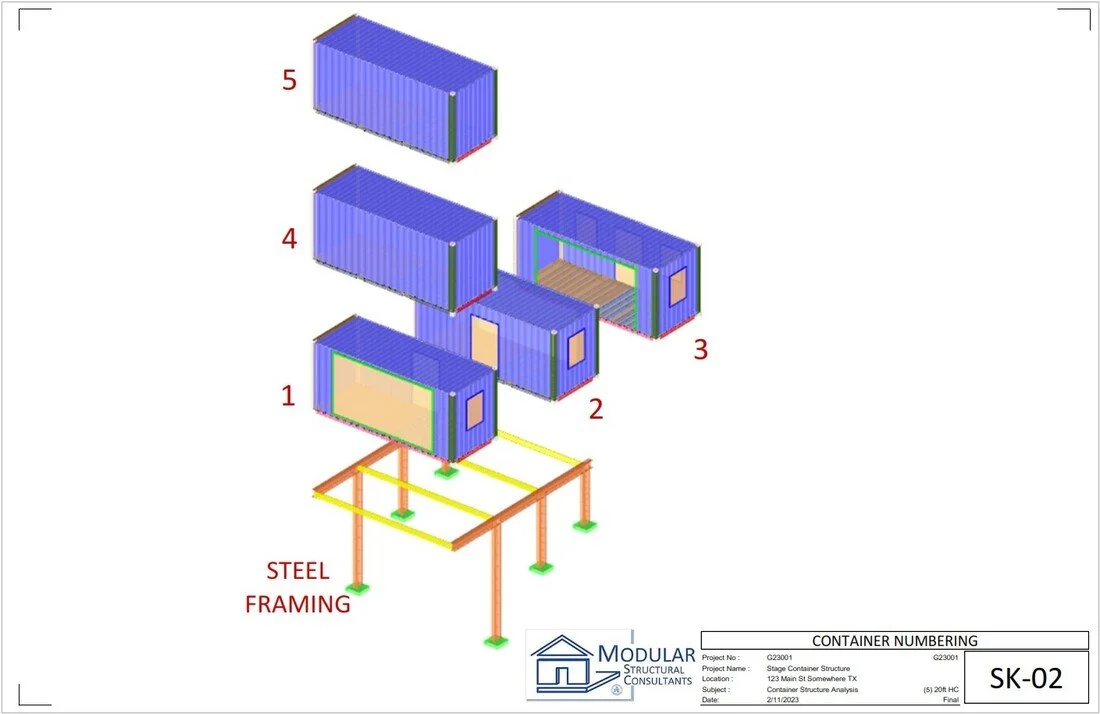
Planning a project with ISO container structures?
Share your layout, container modifications, and project criteria so the structural scope can be reviewed clearly and efficiently.